+91 91577 89399
Call Us

Call Us
Email Us
Get Direction
Systems designed to ensure patient follow-ups, post-discharge continuity, billing communication, and patient recall processes are structured, consistent, and do not depend only on busy hospital staff.
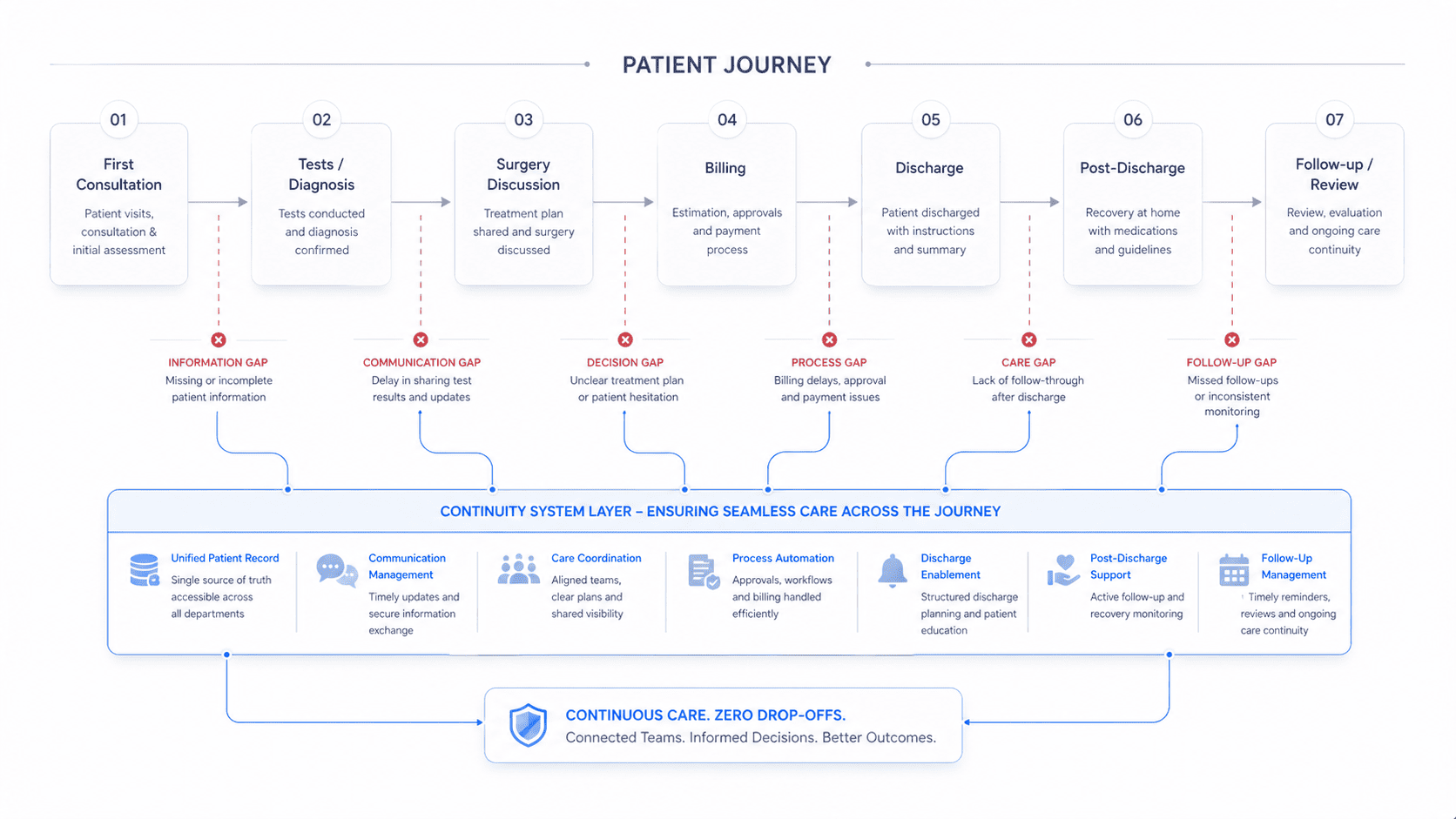
In many hospitals, revenue leakage and patient loss do not happen because there are no patients. They happen because:
These are not medical problems. These are continuity and follow-up system problems.
Hospitals usually lose patients:
Many hospitals focus on acquiring new patients. Very few hospitals build systems to manage continuity with existing patients.
Reactivating dormant patients and reconnecting inactive patient databases who visited once but never returned or did not continue treatment.
Preventing billing disputes, discharge delays, and discount-based revenue leakage through billing communication continuity and pre-discharge billing alignment.
Ensuring doctor-advised follow-ups, review visits, and recall appointments actually happen through structured recall and reminder systems.
Maintaining structured communication with patients after discharge to prevent the 30-day post-discharge silence period and improve patient stability and continuity.
Many hospitals invest heavily in acquiring new patients, but a large amount of growth is often hidden in patients who have already visited the hospital but were never followed up systematically.
| Stage | System |
|---|---|
| First Visit | Recall Engine |
| Tests Advised | Recall Engine |
| Surgery Advised | Revival Loop |
| Estimate Given | Revival Loop |
| Billing | Bill Shock Loop |
| Discharge | Blackout Prevention |
| Post Discharge | Blackout Prevention |
| Review Visits | Recall Engine |
| Old Patients | Revival Loop |
Hospitals do not always need more patients. Many hospitals already have thousands of patients in their database who did not return, did not continue treatment, or did not come back for follow-ups.
Hospital growth and patient care continuity often depend not only on new patient acquisition, but on continuity with existing patients.
That is why we build healthcare continuity systems.